Hospital inventory management for central and departmental stores
Shafa HMS Inventory Management is the stores and stock control module of the Shafa hospital management suite. It covers the central store and the sub-stores in wards, operation theatres, laboratories and outpatient departments, tracking consumables, surgical supplies, reagents, linen and other non-drug items from purchase requisition to consumption. Store keepers raise requisitions, receive goods against purchase orders, issue stock to departments and run periodic counts, while managers see reorder alerts and expiry lists for sterile items. Consumption and stock value post to Accounts, supplier and item masters are shared with Pharmacy, and the interface is available in Bangla and English for hospitals, clinics and diagnostic centres in Bangladesh.
- Central and departmental store control
- Batch and expiry for sterile supplies
- Reorder points with stock alerts
- Consumption posted to Accounts
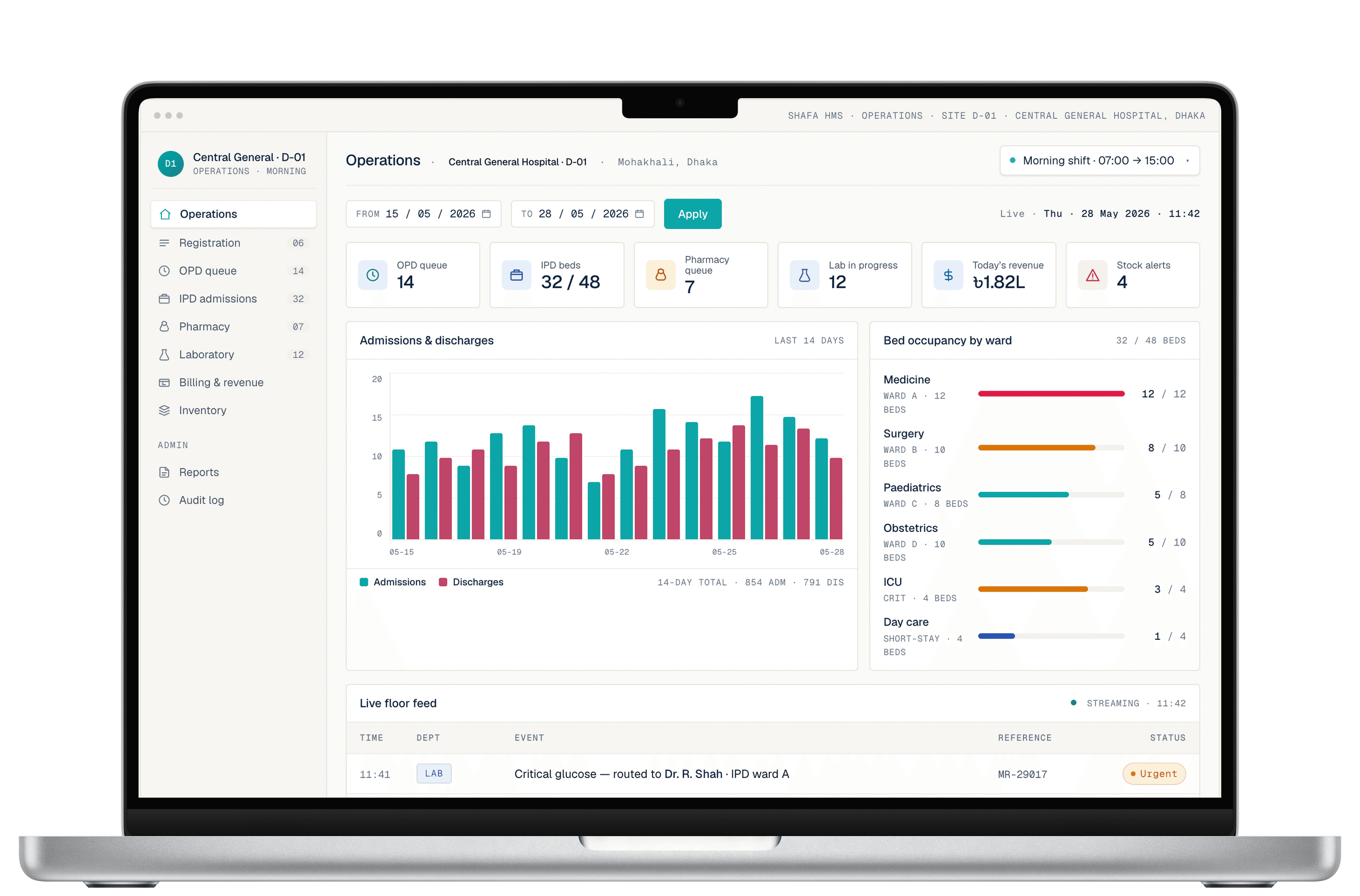
Overview
Stock control for everything a hospital uses that is not a medicine
Hospitals consume a wide range of items that never pass through the pharmacy counter: gloves, syringes, sutures, catheters, dressings, laboratory reagents, cleaning materials, linen, stationery and printed forms. In most facilities these are managed through a stock register in the central store and informal counts in each department, so nobody can say with confidence what is on hand, what has been issued to which ward, or what the month's consumption actually cost. The Inventory module replaces those registers with a single item master and a movement history for every store.
Each store, whether the central warehouse or a shelf in the operation theatre, holds its own balance for every item. Stock enters through goods receipt against a purchase order, moves between stores through issue and transfer documents, and leaves through consumption, write-off or return to supplier. Sterile and dated items carry batch and expiry, so the theatre store can be checked for items due to expire before a list is finalised. Every movement records who did it, when, and against which document.
The module is designed for the people who are asked to explain a variance. Periodic and cycle counts are recorded against the system balance, differences are listed with the movements that could explain them, and adjustments require a reason code before they are posted. Consumption by department, supplier-wise purchases and stock valuation are produced from the same records, giving the finance office cost figures that trace back to individual issues rather than estimates made at month-end.
Capabilities
Inventory management capabilities
Seven areas of stores work, each handled inside the same item master and movement log so that a balance can always be traced to its documents.
- 1
Medical inventory across central and sub-stores
Define the central store and as many departmental sub-stores as the facility runs, each with its own balances, custodians and issue rules. Wards, operation theatres, the laboratory and outpatient units draw from the central store through indents, and their own balances are reduced as items are consumed, so stock held outside the warehouse is visible rather than lost.
- 2
Purchase requisitions and goods receipt
Requisitions are raised by store keepers or generated from reorder points, approved according to the facility's limits, and converted into purchase orders. Goods are received against the order with quantity, batch, expiry and unit cost, short deliveries are recorded as pending, and the supplier invoice is matched to the receipt before it is passed to Accounts for payment.
- 3
Consumables tracking and issue to departments
Issue slips move gloves, syringes, dressings and other consumables from the central store to wards, OT and the laboratory, and consumption is recorded at the point of use where the facility chooses to track it. Managers can see what each department drew during a period, compare it with patient load, and notice unusual usage before the next count.
- 4
Stock management with reorder points and alerts
Minimum, maximum and reorder levels are set per item and per store, and the module lists items that have fallen below their threshold each day. Alerts are routed to the store keeper and the purchasing officer, and a draft requisition is prepared from the shortfall so restocking starts from the system rather than from a walk around the shelves.
- 5
Batch and expiry control for sterile and dated items
Sutures, implants, reagents, catheters and other dated items are received and issued by batch, with issue defaulting to the earliest expiry. Near-expiry reports run per store, expired stock is blocked from issue and moved to a quarantine location, and returns to the supplier are recorded against the original receipt so the credit can be matched.
- 6
Stock audits, counts and variance
Physical counts are scheduled by store, section or item class, entered on a count sheet, and compared with the system balance. Each variance is shown with the movements since the previous count, adjustments are posted only with a reason code and an approver, and the audit log keeps the before and after quantities for internal audit review.
- 7
Medical store management and supplier records
Supplier records hold contact details, items supplied, agreed prices and delivery history, so purchasing can compare suppliers on the same item. Store keepers work from a single item master with units, pack sizes and classifications maintained centrally, and each store's custodian sees only the stock and documents that belong to their location.
Suite fit
How Inventory fits into Shafa HMS
Stores sit between purchasing and every department that consumes supplies, and between the physical shelf and the ledger. Inside Shafa HMS the module receives demand from clinical departments and sends cost and stock figures to Accounts, using the same item and supplier masters as Pharmacy, so no figure is keyed twice.
- Ward, OT and laboratory indentstoInventory issue queue
Departmental requests for consumables and surgical supplies arrive as indents, are approved, and are fulfilled from the central store with an issue document at both ends.
- Goods receipt and supplier invoicestoAccounts payable
Matched receipts and invoices create supplier liabilities and stock value entries in the general ledger without a separate journal.
- Departmental consumptiontoAccounts cost centres
Issues and recorded consumption are summarised by department each period, giving departmental cost reports a supplies line that traces back to individual documents.
- Shared item and supplier mastertoPharmacy Management
Suppliers, units of measure and purchasing rules are maintained once and used by both drug and non-drug stores.
Standards and compliance
Standards, controls and reporting
Stated as it stands today, without claims we cannot support.
HL7 FHIR-based exchange for supply data
Supply items, storage locations and consumption events are modelled on HL7 FHIR resources, so inventory data can be shared with other FHIR-capable systems in the facility without a custom interface for each connection.
Role-based access with audit logs
Store keepers, department custodians, purchasing officers and finance staff each see the stores and documents that belong to their role. Receipts, issues, adjustments and count approvals are logged with user, timestamp and reason, and the log is retained for internal audit review.
Encryption on the network and at rest
Inventory records are encrypted on the network and on disk, including backups, under the HIPAA-style data handling controls that apply to the whole suite.
DGHS reporting formats
Consumables stock and consumption reports can be generated in the formats DGHS uses for facility reporting, so the returns come from the store's own movement records rather than a parallel register.
Deployment
Deployment options
Stores run around the clock and a goods receipt cannot wait for the network. Shafa HMS Inventory is available hosted by Shafa Care, installed on the hospital's own servers, or as a cloud deployment with an offline edge node in the store, and the module works identically in each case. Facilities own their stock data under every model.
Cloud
Hosted by Shafa Care in a database dedicated to your facility, with backups, monitoring and updates handled for you. Additional stores, branches and users are added from the administration screen without new hardware.
On-premise
The suite is installed on infrastructure inside the facility, with stock, supplier and cost records held and backed up on site. Shafa Care maintains and upgrades the software under a support agreement.
Offline sync
An edge node in the central store keeps a local copy of the module, so receipts, issues and counts continue through outages and load-shedding, then synchronise in sequence when the link is restored without duplicating documents.
Who it is for
Who the Inventory module is for
Store keepers and procurement officers
The staff who receive deliveries, fulfil ward indents, chase short supplies and answer for the balance on the shelf, and who currently reconcile a bin card, a register and a spreadsheet that rarely agree.
Nursing in-charges and OT managers
Department leads who hold a sub-store, need to know before a list starts that sterile items are in date and in stock, and want indents fulfilled without a phone call to the store.
Finance heads and hospital administrators
Leaders who need supplies cost by department, stock value at period end and an explanation for every variance, reported on the same basis as the rest of the hospital's accounts.
FAQ
Frequently asked questions
How is the Inventory module priced?
Inventory is licensed as part of the Shafa HMS subscription, priced per facility according to the modules enabled, the number of stores and users, and the deployment model. We do not publish figures because a single-store clinic and a multi-building hospital differ so much. Share your store count and hosting preference and we will prepare a written quote.
We keep stock in registers and Excel today. How does migration work?
The item master, supplier list and opening balances per store are loaded from a spreadsheet template we supply, and the first entry is a physical count that becomes the opening stock. Existing bin cards can run alongside the system for an agreed period, and our team reconciles the first month-end count with you so the starting balances are trusted.
Can the store keep working when the internet is down?
Yes. With an offline edge node in the store, goods receipt, issues, transfers and count entry continue during power cuts and connection failures. Documents are queued locally and synchronised in sequence when the connection returns, so balances at head office catch up without duplicated receipts or double-counted issues.
Do we need Pharmacy or OPD in place before Inventory?
No. Shafa HMS modules are rolled out in phases, and a facility can begin with Inventory and Accounts if stores control is the most urgent gap, adding Pharmacy and the clinical modules later. Because the item and supplier masters are shared, the links to pharmacy purchasing, OT consumption and departmental costing become active as those modules are switched on.
How does inventory data reach Accounts?
Matched goods receipts create supplier liabilities and stock value entries, issues and consumption are summarised by department and cost centre each period, and write-offs and adjustments post with their reason codes. The finance team reviews these entries in Accounts rather than re-entering them from a stores report, so the supplies line in departmental costs traces back to individual documents.
What training is provided for store staff?
Training is delivered by role: store keepers on receipts, issues and counts; department custodians on indents and sub-store balances; purchasing officers on requisitions and supplier records; finance staff on the postings that arrive in Accounts. Sessions are run on your own item list in Bangla or English, on site or remotely, with refresher training available when staff change.
Who owns the stock data, and can we export it?
The facility owns its inventory records in every deployment model. Item masters, movement history, count sheets and supplier records export to standard spreadsheet formats at any time for auditors or regulators, and a complete export is provided if you later leave Shafa HMS. On-premise installations keep the database on your servers from the first day.
Shafa HMS · Inventory
See your store's stock in the system
Bring a page from your central store register and a recent ward indent. In a short session we load a sample of your items, receive a delivery, issue to a ward and run a count, and show where each entry appears in stock balances and in Accounts.